How long does it take to reach band 6?
Based on published IELTS research. Toggle between total hours, weeks, or months based on how you want to plan your study.
Based on Cambridge CEFR research and IELTS published data. Tutored hours are ~30% lower based on Jones (2021). Assumes consistent daily study. Many students reach their target faster with intensive preparation.
Which skills to focus on first
Not all skills produce the same improvement for the same study time. Research on IELTS score gains across thousands of students shows a clear pattern that tells you exactly where to spend your hours.
- Writing: highest average gain of any skill. 0.46 bands over 12 weeks of focused study. Also the lowest-scoring skill globally at a mean of 5.61. Start here as many will struggle.
- Listening: highest-scoring skill globally at a mean of 6.22. Most students are already near band 6 here, maintain it rather than over-investing
- Reading: responds well to timed practice and paraphrase training. Strong return on focused weekly sessions
- Speaking: hardest skill to improve. Research found Speaking gains were not statistically significant over 12 weeks. Needs daily output practice over a long period so make sure to start early
Key insight
If you have limited study time, put it into Writing first. It has the highest average gain of any skill and is where most students are furthest from their target.
What to study for each skill
Focus on the skills furthest from your target first. Here is exactly what to work on in each one.
- 1Writing
Task Achievement first, then vocabulary
Writing Task 2 carries more weight than Task 1 in your Writing band. Task Achievement is the first thing examiners assess (whether you answer the specific question asked). A well-written essay that answers the wrong question cannot score above band 5. After fixing Task Achievement, build topic vocabulary for the six main IELTS topics: environment, education, technology, health, crime, globalisation. Coherence and Cohesion makes up 25% of your Writing band. Logical paragraph structure and basic linking words matter more than complex grammar.
GoalOne timed Task 2 essay per week. 40 minutes, no dictionary. Three minutes planning before writing: task type, position, paragraph ideas. Compare against a model answer after and note every vocabulary gap.
- 2Speaking
Daily output over a sustained period
Speaking is the hardest skill to improve and the slowest to show in scores. Short accurate answers cannot score above band 5 because examiners need enough language to evaluate your ability. For Part 2, use the preparation minute to note four points: position, reason, example, consequence. Speak for the full two minutes. For Part 3, extend every answer to at least four sentences using discourse markers to connect ideas: 'for instance,' 'what I mean is,' 'on the other hand.' Start this habit early as it takes weeks to feel natural.
GoalRecord one Part 2 answer every day. Listen back: at least 90 seconds, a reason, an example, at least one discourse marker. Every single day.
- 3Reading
Paraphrase recognition and timed practice
IELTS Reading answers are almost always paraphrases of the passage. Training yourself to spot paraphrases is more efficient than trying to read faster. For every wrong answer in practice, find the exact line in the passage that contains the answer and identify how the question paraphrased it.
GoalOne timed Reading section per week under exam conditions. Review every wrong answer, find the exact line, identify the paraphrase, write it out before moving on.
- 4Listening
Active preview and answer-type prediction
You have 30 to 45 seconds to preview questions before each Listening section starts. Use it actively to predict the answer type before the audio starts: a number, a name, a place, a reason. This narrows what you are listening for and significantly reduces missed answers. If you are already near band 6 in Listening, one practice section per week is enough to maintain your level.
GoalUse every preview window actively. Predict answer types before the audio starts. One timed Listening section per week as maintenance if already near band 6.
A 12-week plan to reach band 6
12 weeks of consistent focused study produces an average gain of 0.3 bands, with 60% of students gaining at least half a band. The order matters because each phase builds on the previous one.
- 1Weeks 1 and 2
Diagnose and fix Task Achievement
Start with a full timed mock test to establish your current band across all four skills. Then spend these two weeks only on Writing Task Achievement. Study the four task types: opinion, discussion, problem-solution, two-part. For every practice essay, spend three minutes planning before writing. Do not focus on vocabulary or grammar yet.
GoalBy end of week 2: you can identify any Task 2 task type and write a direct structured response to it.
- 2Weeks 3 to 6
Build vocabulary and Speaking output
Start a daily flashcard routine. 10 new IELTS topic words per day using spaced repetition, one sentence written before flipping each card. Focus on the six main topics. At the same time, start your daily Speaking recording habit. One Part 2 answer every day, recorded and listened back. These two habits running in parallel are the engine of this phase.
GoalBy end of week 6: 280 to 420 new topic words in active use, Speaking answers consistently at 90 seconds or more with a clear reason and example.
- 3Weeks 7 to 10
Timed practice across all four skills
Add timed Reading and Listening sections to your weekly routine. One of each per week. Submit at least one Task 2 essay to a qualified IELTS tutor during this phase as self-assessment of writing is unreliable at band 5 level. Use the feedback to identify which of the four Writing criteria is pulling your score down.
GoalBy end of week 10: clear picture of your band in each skill from timed practice, and specific tutor feedback on your Writing criteria.
- 4Weeks 11 and 12
Switch to exam simulation mode
Test familiarity gains plateau after around 4 weeks of intensive prep. Use these final two weeks for full mock tests under real exam conditions: timed, no dictionary, no stopping. Review every wrong answer in detail. This phase is not about learning new content. It is about making your current level show up reliably on exam day.
GoalBy exam day: mock test scores reflect your real band and you know exactly what to expect from each section.
Mistakes that stop students reaching band 6
The real-world success rate for IELTS improvement attempts is around 47%. These are the patterns that put students in the other 53%.
- 1Mistake 1
Spending most time on Listening and Reading
Listening and Reading are the most comfortable skills to practise alone. Many students spend the majority of their time here because it feels productive. But the overall band is the average of all four skills. If Writing is at 5.0 and Listening is at 6.5, no amount of Listening practice will move the overall to 6.0.
GoalCheck your score by skill. If Writing or Speaking is more than one band below your target, spend at least half your total study time on those two skills only.
- 2Mistake 2
Recognition vocabulary instead of production vocabulary
Most students can recognise far more vocabulary than they can produce under exam pressure. They read model answers and understand every word, but when writing their own essay those words do not appear. Vocabulary study was passive: reading lists, watching videos, highlighting. Vocabulary you have only recognised is not available when you need it.
GoalWrite a sentence using each new word before flipping the card. Three original sentences per vocabulary session minimum. Recognition without production does not move your band score.
- 3Mistake 3
Answering the topic instead of the specific question
Many students prepare model essays for broad topics and reproduce them regardless of what the question asks. Task types are specific - opinion, discussion, problem-solution, two-part questions each require different structures. Reproducing the wrong structure is an automatic band 5 for Task Achievement regardless of vocabulary quality.
GoalBefore every practice essay: identify the task type, write your specific response approach in one sentence, then start writing. Never skip this step.
- 4Mistake 4
Stopping the daily habit in week three
Around 60% of students who study consistently for 12 weeks improve by at least half a band. The most common reason students fall into the other 40% is due to stopping their daily routine in weeks three or four. The first two weeks feel motivated. Week three is where most students drop off because results are not yet visible.
GoalSet a fixed daily study time and treat it as non-negotiable for the first six weeks. The habit becomes self-sustaining after six weeks, not two.
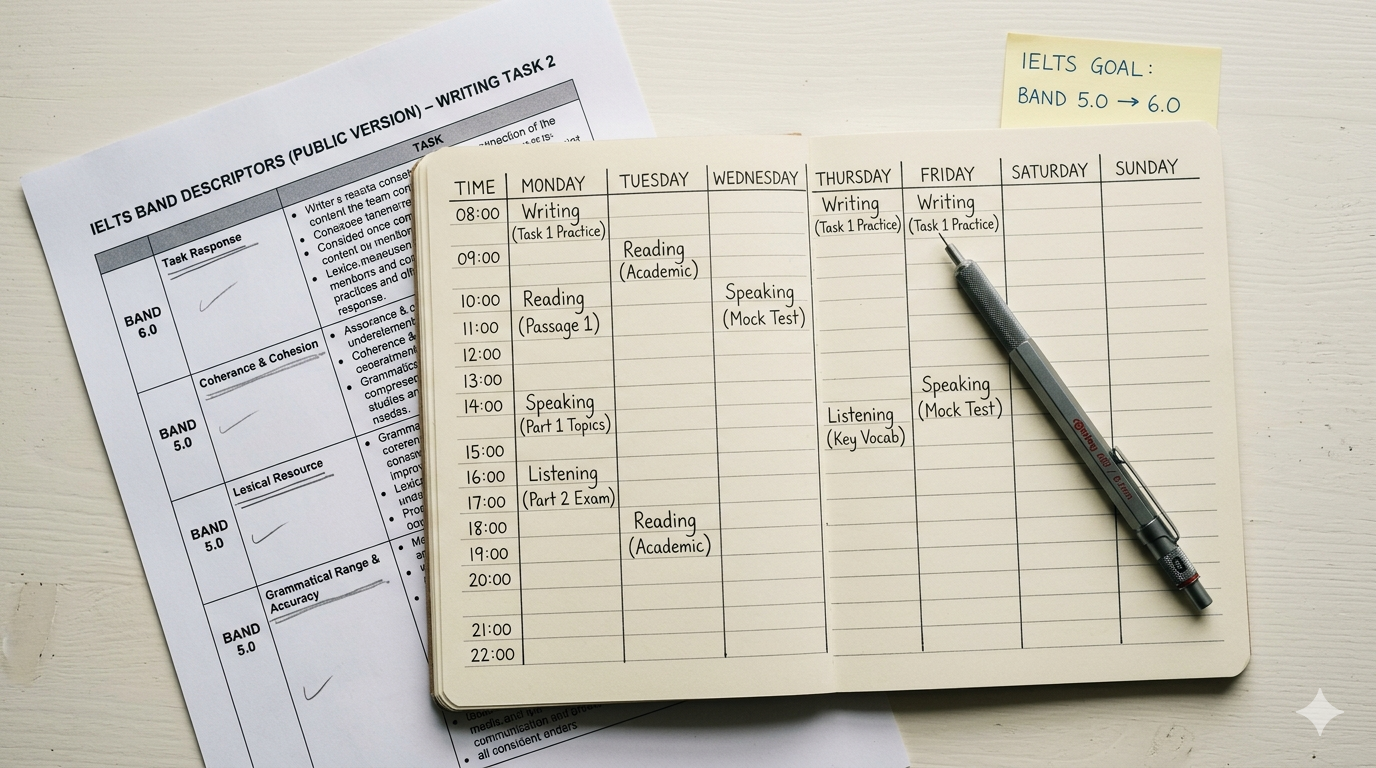
A student at band 5.5 wants to reach band 6. Their scores are: Listening 6.5, Reading 6.0, Writing 5.0, Speaking 5.5. They have 1.5 hours per day. Which plan gives them the best chance?
This student has studied for two months but their Writing score has not moved from 5.0. Identify what is wrong and rewrite their routine with two concrete fixes. 'Every week I do one Cambridge practice test for Listening and Reading. I watch two IELTS YouTube videos on writing techniques and note down vocabulary and structures. On the weekend I read three model band 7 essays on the topics I watched. I feel like I understand what a good essay looks like but my Writing score is still 5.0.'
Find out how long it will take you specifically
The hours in the table above are averages. ClayLingua's free score predictor uses data from 11 published research studies to give you a personalised time-to-target estimate based on your current band, study hours per day, and whether you are studying alone or with a tutor.