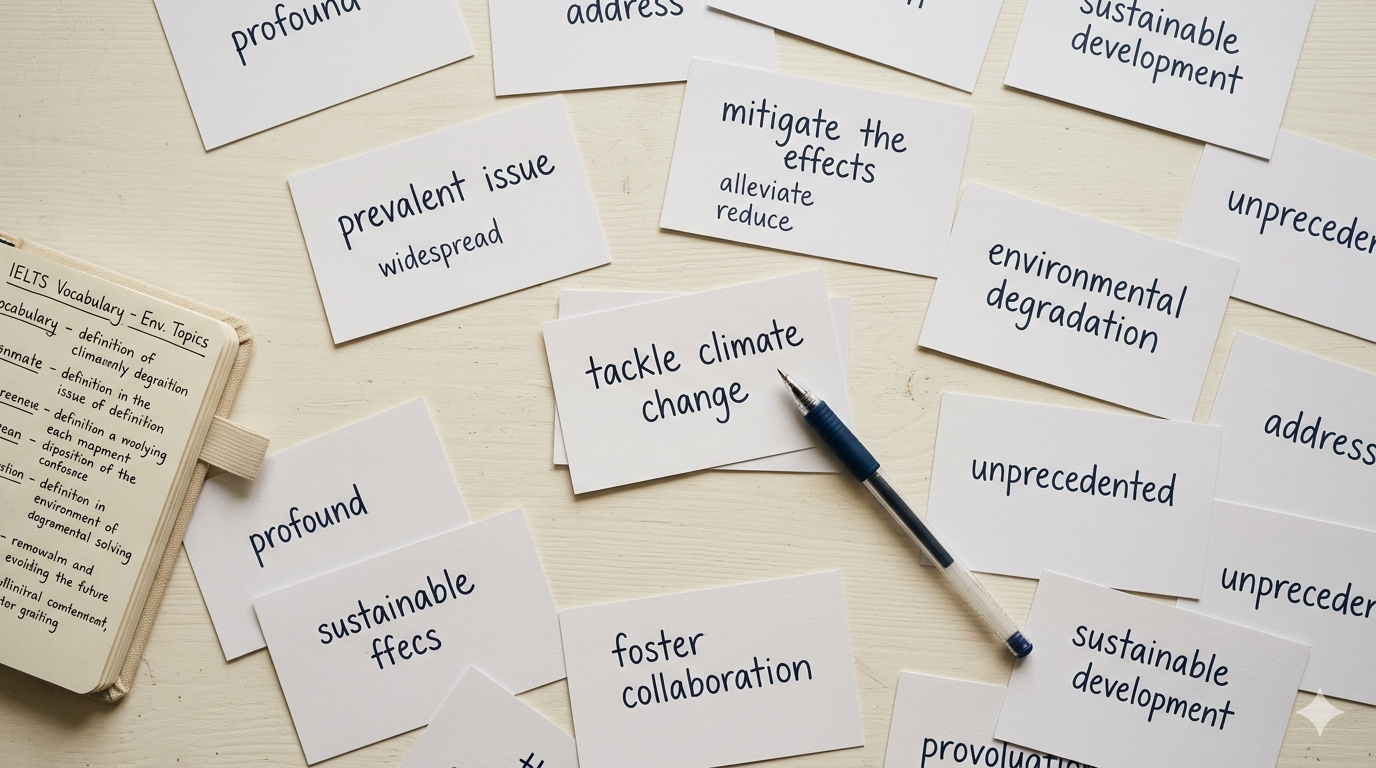
The fastest way to learn IELTS vocabulary (free)
If you want to improve your IELTS vocabulary quickly, follow this simple system.
- Learn 10-20 new words per day
- Test yourself by reviewing the words you learned
- Review words at the right time
- Use each word in a sentence
Key insight
Flashcards teaches you the ability produce language instead of just recognising it
A simple 20-minute daily plan
Use this structure every day to build usable vocabulary.
- 5 minutes → review old words
- 10 minutes → learn 10–20 new words
- 5 minutes → write 1–2 sentences using new words
- Consistency matters more than doing more. A small daily habit beats long irregular sessions.
Want this system done for you?
You can follow this manually or use a system that schedules reviews and tracks your progress automatically.
Why this method works
Flashcards are unlike any other method. They force you to recall words actively under pressure which will significantly accelerate your speed of learning.
- Active recall forces you to remember words
- Spaced repetition shows words at the right time just before you forget them
- Sentence practice turns knowledge into usable language
Key insight
Improving vocabulary is one of the fastest ways to increase your IELTS band score.
The easiest way to follow this system
You can use a notebook and pen, but you must decide what to review and when.
- A system can show the right word at the right time
- It forces you to recall before checking
- It removes guesswork from your study
Note
This system is called flashcards with spaced repetition.
Why timing matters when learning vocabulary
Without review, most vocabulary is forgotten quickly. The key is reviewing at the right time.
- Words you know well appear less often
- Difficult words appear more often
- Each review strengthens long-term memory
- After several reviews, you will recall words automatically
Key insight
The difference between Band 5 and Band 7 vocabulary is not how many words you’ve seen, it's how many you can produce.
Band comparison
Two students both learn 10 new IELTS words
Studies a list and reviews randomly. Words feel familiar but are not used in writing or speaking.
- ✗No structured review timing
- ✗Recognition only
- ✗Words forgotten quickly
Uses a system with repeated recall at the right intervals. Words appear naturally in writing and speaking.
- ✓Structured review system
- ✓Active recall every session
- ✓Words become usable
Four rules for learning IELTS vocabulary effectively
Follow these rules to make sure your study improves your score.
- 1Rule 1
Focus on IELTS topics
Study vocabulary by topic such as environment, education, and technology.
GoalBe ready for real exam questions.
- 2Rule 2
Learn collocations
Learn how words are used in sentences, not just definitions.
GoalUse vocabulary accurately.
- 3Rule 3
Use spaced repetition
Review words at the right time instead of repeating everything daily.
GoalRemember more with less effort.
- 4Rule 4
Limit new words
Learn 10-20 new words per day to avoid overload.
GoalStay consistent long-term.
Daily words targets by goal band
This will give you a brief idea of how many cards to study per day to reach your target band. These timelines assume daily consistency. The most common reason students do not hit their target is by stopping the daily habit in week three.
- Band 5→6 (target: ~1,000 new IELTS words) 10 new cards/day, ~15 min/day, ~14 weeks to target
- Band 6→6.5 (target: ~1,500 new IELTS words) 15 new cards/day, ~20 min/day, ~14 weeks to target
- Band 6→7 (target: ~2,000 new IELTS words) 20 new cards/day, ~25 min/day, ~14 weeks to target
- Band 7→8 (target: advanced new IELTS words) 15 new cards/day, ~20 min/day, ongoing
Watch out
Do not increase your daily new card limit mid-study. Your review queue grows with every card you add. Raising the limit too fast creates an unmanageable queue within two weeks and that is when most students quit.
A simple 4-week plan using band-based vocabulary
Start at your current level and stay consistent. At 10 new words per day, you will learn 280 new words over 4 weeks. Remember to make use of your newly learned vocabulary by using it in mock tests and practice exercises.
- 1Week 1
Start at your current band
Begin with the deck that matches your level (for example, Band 4–5). Learn 10 new words per day and complete all reviews. Before flipping each card, say or write a sentence using the word.
GoalBuild a consistent daily habit and turn passive vocabulary into active use.
- 2Week 2
Stabilise and strengthen
Continue with the same band deck. Focus on accuracy and correct usage, not just meaning. If a word feels difficult, spend more time using it in sentences.
GoalMake vocabulary reliable enough to use in writing and speaking.
- 3Week 3
Build consistency under load
Continue your daily routine and make sure you never skip your review queue before learning new words. As your total number of cards increases, your review sessions will naturally become more important than new learning.
GoalStrengthen long-term memory through consistent reviews and accurate sentence use.
- 4Week 4
Apply in real IELTS tasks
Write one timed IELTS Task 2 essay or practise speaking. Try to use vocabulary you have learned. Afterward, identify missing or incorrect usage.
GoalTurn vocabulary into real exam performance.
Quick check
A student has 20 minutes to study IELTS vocabulary. They have ClayLingua flashcards open. Which session is most likely to improve their band score?
This student is using flashcards but not improving. Identify what is wrong and rewrite their daily routine with one concrete fix. 'Every evening I open my IELTS flashcard app and go through my review queue. I look at each card, read the word, flip it to check the definition, and mark it as 'remembered' or 'forgotten.' I usually do this for about 20 minutes. I've been doing this for three weeks and my vocabulary feels bigger, but I'm not sure it's showing up in my writing.'
Start learning IELTS vocabulary faster
Follow this method yourself or use ClayLingua's flashcard system to automate it. It schedules reviews, tracks your progress, and helps you build vocabulary you can actually use in the exam.