Why You're Stuck at Band 5
Most students at band 5 have decent English. They understand the question. They write something. They hand it in. And they get 5.0 or 5.5 every single time. The problem isn't vocabulary or grammar. It's that IELTS Writing is marked against four specific criteria that band 5 essays fail in very predictable ways. Once you know what examiners are actually looking for, the path to band 6 becomes clear. This lesson covers all four criteria, shows exactly where band 5 essays go wrong in each one, and gives you a concrete plan to fix it.
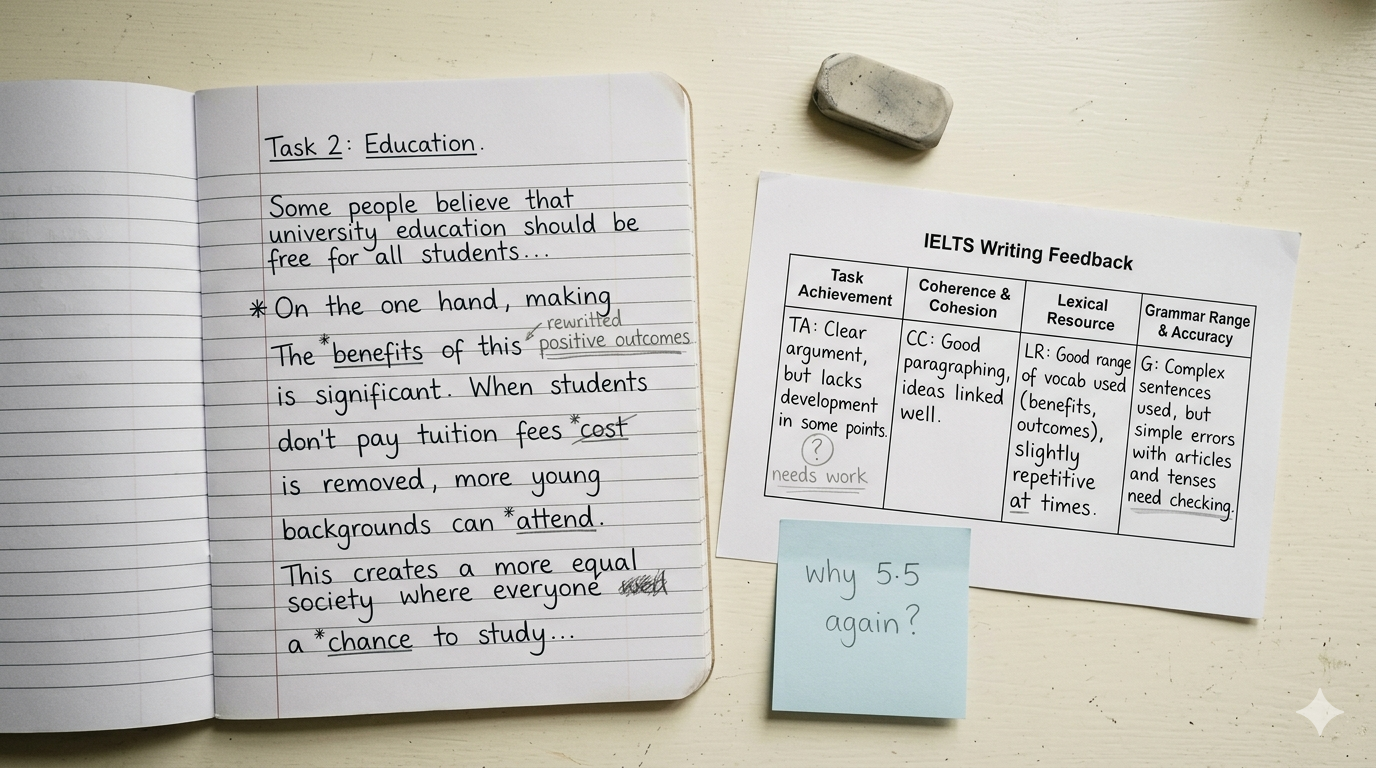
How IELTS Writing is marked
Your Writing band is the average of four criteria, each worth 25% of your score. If any one of them is low, it pulls everything down.
- Task Achievement (Task 2) / Task Response. Did you answer the specific question asked?
- Coherence and Cohesion. Is your essay easy to follow, with clear paragraphs and logical flow?
- Lexical Resource. Is your vocabulary range and accuracy strong enough?
- Grammatical Range and Accuracy. Do you use a variety of sentence structures correctly?
Key insight
Most band 5 essays are pulled down by Task Achievement and Lexical Resource, not grammar. Students spend weeks on grammar and see no improvement because those aren't the real problems.
Criterion 1: Task Achievement
This is the first thing an examiner checks. At band 5, the most common problem is answering the topic instead of the question.
- 1The problem
Writing about the topic, not the question
IELTS Task 2 has five question types: opinion, discussion, problem-solution, two-part, and advantage-disadvantage. Each one needs a different response structure. If the question asks 'to what extent do you agree?' and you write a discussion essay presenting both sides equally with no clear position, your Task Achievement score drops to band 5 regardless of how good the writing is. Examiners see this mistake daily.
GoalBefore writing a single word, read the question twice. Identify the task type. Write your position or approach in one sentence. Only then start the essay.
- 2The fix
Plan for three minutes before writing
Students who plan for three minutes before writing consistently outperform students who dive straight in. Your plan doesn't need to be detailed. Example: task type, your main position, and one idea per body paragraph. That's it. This three-minute investment fixes the most common Task Achievement errors.
GoalNever skip the planning step. One sentence per paragraph in your plan, written before you start. This prevents you from drifting away from the question mid-essay.
Band comparison
Question: 'Some people think technology has made our lives more complicated. To what extent do you agree?'
Technology has both advantages and disadvantages in modern life. On one hand, technology helps us communicate faster. On the other hand, some people think it creates problems. In conclusion, technology can be both helpful and harmful depending on how we use it.
- ✗No clear position. The question asks 'to what extent do you agree', not 'discuss both sides'
- ✗The conclusion avoids committing to any view
- ✗Task type misread. This is an opinion essay, not a discussion essay
I largely agree that technology has made daily life more complex, primarily because it has created new pressures around productivity and communication that did not exist a generation ago. While technology solves many practical problems, the expectation of constant connectivity has introduced a layer of cognitive load that outweighs those gains for many people.
- ✓Clear position stated in the first sentence
- ✓Directly addresses 'to what extent' not just 'yes' or 'no' but with a nuanced degree
- ✓Body paragraph follows a single developed argument, not a list of pros and cons
Criterion 2: Coherence and Cohesion
This criterion is about how easy your essay is to follow. Band 5 essays are often difficult to read because the structure is unclear or the linking words are overused and mechanical.
- 1The problem
Listing ideas instead of developing them
A very common band 5 pattern: one short paragraph after another, each with a different idea but no development. 'Firstly... Secondly... Thirdly... In conclusion.' This looks structured but it isn't. Examiners want to see one idea per paragraph, explained fully with a reason and an example. Three underdeveloped ideas score lower than one well-developed one.
GoalEach body paragraph should cover one idea only: make the point, explain why it's true, and give a specific example. Three sentences minimum per paragraph before moving on.
- 2The problem
Overusing linking words
Starting every sentence with 'Furthermore,' 'Moreover,' 'In addition,' or 'Additionally,' is a band 5 signal. Examiners know what this looks like and it doesn't impress them. These words are supposed to connect ideas. However, when every sentence starts with one, they stop doing that job. Natural academic writing uses linking words selectively, not as sentence starters on autopilot.
GoalUse one discourse marker per paragraph at most. If you're starting every sentence with 'Moreover' or 'Furthermore', replace most of them with normal connectors: 'This means that...', 'As a result...', 'For example...'
Criterion 3: Lexical Resource
This is where most band 5 students leave the most marks behind. Lexical Resource is about using words accurately together. Students tend to mistake lexical resource for just how many words you know. Examiners reward collocations: words that go together the way native speakers use them.
- 1The problem
Translating ideas word-for-word from your native language
For example, Thai and English combine words very differently. In Thai, word pairings are flexible. In English, they're fixed. You can't 'make a decision' and 'do a decision' interchangeably. One is correct, and one isn't. When students translate ideas directly from Thai, they produce sentences that are technically understandable but unnatural. Examiners call this 'inappropriate collocation' and it's one of the clearest signals of a band 5 Lexical Resource score.
GoalLearn vocabulary in phrases, not in single words. 'Environment' is not a vocabulary item, 'address environmental concerns', 'pose a serious threat to the environment', and 'place a strain on natural resources' are. Always learn how a word is used, not just what it means.
- 2The problem
Using the same words repeatedly
Band 5 essays often repeat the same five or six words throughout. 'Important' appears in every other sentence. 'Society' and 'people' are used interchangeably without variation. This signals a limited vocabulary range, which is exactly what Lexical Resource measures. The fix is building topic-specific vocabulary so you have real alternatives when you're writing under pressure.
GoalFor every IELTS essay topic, know at least three ways to express the central idea. If the topic is education, you should be able to vary between 'academic institutions', 'educational systems', 'schooling', 'formal education' and know when each one fits.
Band comparison
Topic: 'The environment is under threat. Who is responsible for protecting it?'
The environment is very important. People should protect the environment. The government is also important for protecting the environment. Everyone should try to help the environment because it is important for the future of society.
- ✗'Important' used three times. No vocabulary range shown
- ✗'Environment' repeated six times with no variation
- ✗No collocations. No evidence of topic-specific vocabulary
Responsibility for protecting natural ecosystems should be shared rather than assigned to a single actor. Governments are best placed to enforce environmental legislation and fund conservation efforts at scale, while individuals can reduce their personal impact through consumption choices. Neither group can address ecological decline effectively without the other.
- ✓Topic vocabulary varied: 'natural ecosystems', 'environmental legislation', 'conservation efforts', 'ecological decline'
- ✓Collocations are natural: 'enforce legislation', 'fund conservation efforts', 'address decline'
- ✓No repetition of 'environment'. The meaning is carried by varied terms
Criterion 4: Grammatical Range and Accuracy
This is the criterion most students focus on, and for most band 5 essays it's not the main problem. That said, there are a few specific grammar patterns that pull scores down and are worth fixing.
- 1The problem
Writing only simple sentences
Band 5 is described by IELTS as 'attempts complex sentences but with limited success'. Band 6 requires complex sentences used accurately. If your essay is mostly short simple sentences, you're already capped at band 5 for this criterion even if every sentence is grammatically correct. You need relative clauses, conditional structures, and passive voice used accurately.
GoalIn every paragraph, write at least one complex sentence using a relative clause ('which', 'that', 'who') or a conditional structure ('if... then'). One per paragraph is enough to demonstrate range.
- 2The problem
Article and preposition errors
Languages like Thai don't use articles (a, an, the) or prepositions in the same way English does. This creates consistent errors that examiners notice immediately: 'the government should invest in the education' instead of 'in education', or 'people depend in technology' instead of 'on technology'. These errors are common, they're fixable, and they're worth targeting specifically because they appear in almost every sentence.
GoalAfter every writing session, go back through your essay and check every 'the' and every preposition. Ask yourself: is 'the' needed here? Is this the right preposition? This review takes two minutes and catches most of these errors.
A student writes this essay introduction: 'Nowadays, technology is developing very fast in the world. Technology has many advantages and disadvantages. This essay will discuss both sides of technology and give my opinion at the end.' The essay question was: 'Technology has created more problems than it has solved. Do you agree or disagree?' What is the main problem with this introduction?
What to actually do about it
Each criterion has a different fix, and trying to improve all four at once usually means improving none of them. Work through these in order.
- 1Fix 1. Week 1 and 2
Diagnose your task type problem first
Before anything else, you need to know which task types you're getting wrong. Write one essay for each of the five Task 2 types: opinion, discussion, problem-solution, two-part question, and advantage-disadvantage. Compare each one against a model answer. For every essay where your structure doesn't match the model, you know which task type to fix. Most band 5 students have one or two types they consistently misread.
GoalBy the end of week 2: you can identify any Task 2 question type on sight and write the correct opening paragraph for it.
- 2Fix 2. Week 3 and 4
Build topic vocabulary as phrases, not words
Pick the six main IELTS topics: environment, education, technology, health, crime, globalisation. For each topic, learn ten collocations.. 'Tackle climate change', 'bridge the educational gap', 'pose a cybersecurity risk'. Write one original sentence using each phrase on the same day you learn it. This converts recognition into production, which is the only vocabulary that helps you in an exam.
Goal10 new topic phrases per day, one sentence each. After four weeks you'll have around 250-300 usable collocations across all six main topics.
- 3Fix 3. Week 5 and 6
Rewrite your paragraph structure
Stop writing lists of ideas. For every body paragraph, use this structure: make one point, explain why it's true, give one specific example. That's it. Three to five sentences per paragraph, all building on the same idea. If you find yourself starting a new sentence with 'Also,' or 'Another point is...', you've started a new paragraph idea in the middle of the old one. Stop and finish the first idea properly.
GoalOne timed essay per week, 40 minutes, no dictionary. After writing, check that every body paragraph has exactly one central idea, a reason, and an example.
- 4Fix 4. Ongoing
Get your writing checked by someone who knows the criteria
Self-assessment of Writing is unreliable at band 5. You don't yet have a clear picture of what band 6 looks like at the criterion level, which means you can't accurately identify your own errors. Reading model answers helps, but comparing your own essay against the four marking criteria with a qualified teacher is significantly faster. Even two or three sessions of proper feedback can clarify exactly which criterion is holding your score back.
GoalSubmit at least one Task 2 essay to a qualified IELTS teacher for criterion-level feedback before your next exam attempt.
This student has been at band 5 for two attempts. Read their plan and identify what's wrong with it. 'I failed band 6 twice. Both times my Writing was 5.5. My plan for the next attempt: I'm going to study grammar every day for 6 weeks using an advanced grammar book. I'll focus on complex sentences and passive voice. I'll also memorise a list of 200 advanced IELTS words. On weekends I'll read model band 7 essays to understand the style.'
Why vocabulary is usually the fastest way out of band 5
Of the four criteria, Lexical Resource responds fastest to targeted study. Task Achievement takes a while to internalise across all task types. Coherence takes practice to restructure writing habits. Grammar is slow to shift. But vocabulary can improve noticeably within four to six weeks if you study the right things in the right way. The reason most students don't see that improvement is that they study vocabulary passively. They read word lists. They watch YouTube videos. They highlight model answers. None of that builds the ability to produce vocabulary under exam pressure. The only thing that does is active recall: trying to produce the word before you see it.
Key insight
The gap between band 5 and band 6 vocabulary is not about knowing more words. It's about having words available when you need them, under timed conditions, without a dictionary.
Start building the vocabulary that moves your Writing band
ClayLingua's IELTS flashcard decks are built around the six main exam topics, with collocations rather than single words. Each card includes the phrase used in a sentence. Free to use with a daily spaced repetition queue so you review words at the right time and don't forget them. If you want criterion-level feedback on a real essay, our tutors give written feedback mapped to all four IELTS marking criteria.