
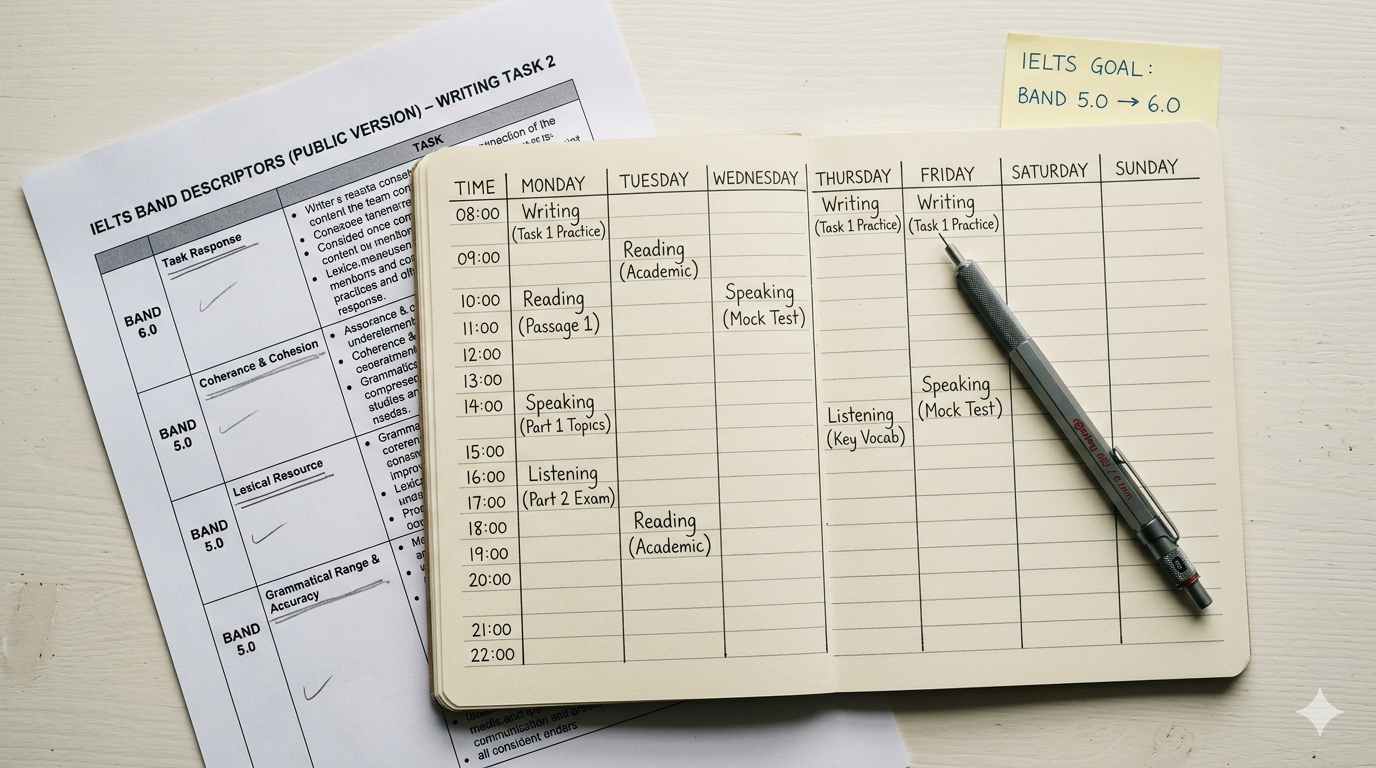
IELTS band 7 in short
IELTS band 7 means you are a "good user" of English: you have operational command of the language, with occasional mistakes and misunderstandings in some situations. It is roughly CEFR level C1. To get it, you need about 30 correct answers out of 40 in Listening and Academic Reading (about 34 in General Training Reading), and Writing and Speaking that meet the band 7 criteria.
- Overall 7.0 needs your four skill scores to add up to 27 or more. An average of 6.75 rounds up to 7.0.
- Band 7 is the most common target among learners on ClayLingua: 39% of 67 learners starting from 5.0 or 5.5 aimed for it.
- Writing has the lowest average of the four skills for Thai test takers. Band 7 Writing needs developed ideas, precise vocabulary and frequent sentences with no errors.
How many correct answers do you need for band 7?
Listening and Reading each have 40 questions. Your number of correct answers is converted to a band score. Writing and Speaking are marked against four criteria each, so they have no correct answers.
Approximate. IELTS publishes average marks of 30 and 35 for Listening and Academic Reading bands 7 and 8, and 35 for General Training Reading band 7. Exact numbers change a little between test versions. CEFR levels are a rough comparison.
Add up your four scores: how far are you from 7.0?
Your overall band is the average of your four skills, rounded to the nearest half band. For 7.0, your four scores need to add up to 27 or more. A total of 26.5 gives an average of 6.625, which rounds down to 6.5. A half band in any skill adds the same amount to your total.
- Example: Listening 7.5, Reading 7.0, Writing 6.0 and Speaking 6.0 add up to 26.5, which is overall 6.5. Raise Writing or Speaking to 6.5 and the total is 27, which is overall 7.0.
- Some courses and visas that need 7 ask for 7.0 in each skill, not just overall. If that is you, the total does not help: every skill has to reach 7.
Key insight
Add up your four scores now and find your total in the table below. For every band, see IELTS band scores explained.
How far is your total from 7.0?
Add your four skill scores together, find your total, and see what the gap means in practice.
- Overall band
- 6.0
- Points to 7.0
- 2.5 to 4.0
- What that could look like
- Progress in more than one skill, not just one
- Overall band
- 6.5
- Points to 7.0
- 2.0
- What that could look like
- Half a band in all four skills, or a full band in two
- Overall band
- 6.5
- Points to 7.0
- 1.5
- What that could look like
- Half a band in three skills
- Overall band
- 6.5
- Points to 7.0
- 1.0
- What that could look like
- Half a band in two skills, or a full band in one
- Overall band
- 6.5
- Points to 7.0
- 0.5
- What that could look like
- Half a band in just one skill
- Overall band
- 7.0
- Points to 7.0
- 0
- What that could look like
- You already have 7.0. Check whether you need 7.0 in each skill.
The overall band is the average of the four skills. An average ending in .25 rounds up to the next half band, and .75 rounds up to the next whole band. Totals go up in steps of 0.5 because each skill is scored in half bands.
See how long band 7 will take you
Enter your scores, exam date and study time to see the band you could reach by your exam and what to study each day. About 1 minute, no sign up needed.
How long does it take to reach band 7?
It depends on where you start. From 6.5, band 7 is half a band. From 6.0 it is a full band, and from 5.5 it is a band and a half. In one IELTS research study, learners who prepared for 12 weeks gained about 0.3 of a band overall on average, so a full band usually takes much longer than three months.
- From 6.5 (a total of 25 to 26.5): plan for around three months, focused on the criteria that are still below 7.
- From 6.0 (a total of 23 to 24.5): plan for six months or more, with regular feedback on Writing and Speaking.
- From 5.5 or below: aim for 6.5 first. The band 6.5 guide shows the steps, and band 7 becomes your next goal.
Note
Research gives averages, not promises. Your own timeline depends on your scores, which skills are lowest, and how much you can study each week.
What examiners look for at band 7
Band 7 is not about difficult words or long sentences. It is about control: your ideas are developed, your language is precise, and mistakes are occasional rather than regular. These are the main differences from band 6 in the official descriptors, in plain English.
- Writing, Task Response: a clear position throughout, and main ideas that are extended and supported, not only stated.
- Writing, Coherence and Cohesion: ideas organised logically with clear progression, and linking words used flexibly rather than in a fixed pattern.
- Writing and Speaking, Lexical Resource: some less common words and phrases, used with an awareness of style and collocation.
- Writing and Speaking, Grammatical Range and Accuracy: a variety of complex structures, and frequent sentences with no errors.
- Speaking, Fluency and Coherence: long answers without noticeable effort, with only occasional hesitation.
Key insight
Frequent sentences with no errors is the line that stops many learners at 6.5. Complex sentences with mistakes do not help you. Shorter sentences that are fully correct often score better.
Which skills to focus on first
In IELTS's results for Thai Academic test takers (2024 to 2025), the average was 6.54 in Reading, 6.24 in Listening, 5.95 in Speaking and 5.81 in Writing. For band 7, Reading and Listening are usually the closest, and Writing and Speaking need the most work.
- Reading and Listening: about 30 correct answers out of 40. Accuracy on the hardest question types matters more than speed.
- Writing: the biggest gap for most Thai learners, and the skill that improved most in a 12 week IELTS study.
- Speaking: slow to improve, so start daily practice early. Band 7 needs longer, natural answers, especially in Part 3.
Key insight
Averages describe all Thai test takers, not you. Start with your own lowest skill, and check whether your goal needs 7 in each skill.
What to study for each skill
At band 7, the work is precise and specific. Here is what to focus on in each skill.
- 1Writing
Precision in every paragraph
Band 7 essays answer the exact question, keep one position from start to finish, and support each main idea with an explanation and a specific example. Then work on accuracy: write fewer, clearer complex sentences rather than many long ones with errors. Learn vocabulary as collocations, such as 'a significant impact' or 'address a problem', rather than as single words.
GoalOne timed Task 2 essay per week, marked by criterion at least twice a month. Keep an error log and check each new essay for your three most common mistakes. The ClayLingua courses include a Writing band 6 to 7 module.
- 2Speaking
Natural, developed answers
Band 7 speakers keep going without effort and use some less common and idiomatic language naturally. Memorised answers do the opposite: they sound fluent for a moment and then break down. Practise answering unexpected Part 3 questions: give your view, explain it, add an example, and consider another side. Work on stress and intonation, not only on individual sounds.
GoalRecord one Part 2 and three Part 3 answers every day. Listen back for hesitation, repeated words and flat intonation. The speaking drills give you new prompts.
- 3Reading
Accuracy on the hardest questions
At band 7 you can only miss about 10 questions. Most of those losses come from True, False, Not Given, matching headings, and answers that are paraphrased. Read the question carefully, find the exact sentence in the passage, and check whether the meaning matches, not just the words.
GoalOne timed Reading test per week. Keep a list of wrong answers by question type and practise your weakest type, for example with the paraphrase matching drill.
- 4Listening
Parts 3 and 4, and spelling
Band 7 needs about 30 correct answers, so you can lose very few marks in Parts 3 and 4. Speakers in these parts disagree, correct themselves and use paraphrases. Spelling and plural mistakes also cost marks at this level, because an answer with a spelling mistake is marked wrong.
GoalOne full timed Listening test per week, for example from a ClayLingua mock test. Check every answer for spelling and plurals before you review the meaning.
Band comparison
Band 6 and band 7 Writing: the same paragraph
Task 2 question: 'Some people believe that governments should spend money on public transport rather than building new roads. To what extent do you agree or disagree?'
I agree that governments should spend more money on public transport. Public transport is good for the environment because it reduces pollution. If more people use buses and trains, there will be less cars on the road. For example, in Bangkok the BTS helps many people to travel to work. So public transport is better than building new roads.
- ✗A clear position, but the reasons are general ('good for the environment').
- ✗The example is relevant but not explained: how does the BTS reduce traffic or pollution?
- ✗A grammar error ('less cars' instead of 'fewer cars') and simple linking ('So').
I largely agree that public transport deserves a greater share of government spending. New roads tend to fill up again within a few years, because they encourage more people to drive. A reliable rail network, by contrast, can move far more people using the same space. Bangkok illustrates this well: along the BTS and MRT lines, many commuters now take the train to work instead of driving, which a new expressway alone could not achieve.
- ✓The position is precise ('largely agree') and kept throughout.
- ✓The main idea is explained with a cause ('because they encourage more people to drive') and a contrast.
- ✓The example supports the argument, and the vocabulary is precise ('a greater share', 'illustrates', 'by contrast').
Band comparison
Band 6 and band 7 Speaking: the same question
Part 3 question: 'Do you think technology has made people's lives less stressful?' Both answers are written out from speech. Pronunciation is also marked, but it cannot be shown in text.
I think technology makes life easier but not less stressful. For example, we can use mobile banking and order food online, so we save a lot of time. But on the other hand, people check their phone all the time and they can't relax. My friends always reply to work messages at night. So I think it is more stressful now.
- ✗A clear opinion with examples on both sides.
- ✗Mostly accurate, but the vocabulary is common and some phrases are repeated ('I think', 'so').
- ✗Ideas are listed rather than linked: why does saving time not reduce stress?
In some ways, yes, but I'd argue it's shifted the stress rather than removed it. Everyday tasks like paying bills or booking a doctor's appointment take seconds now, which is a genuine relief. The trouble is that the time we save tends to get filled with more work. Because we're always reachable, there's this unspoken expectation that you'll reply to your boss at ten at night, so it's harder to switch off than it used to be.
- ✓A precise position ('shifted the stress rather than removed it') that is explained step by step.
- ✓Natural, less common language ('a genuine relief', 'unspoken expectation', 'switch off').
- ✓Discourse markers such as 'The trouble is' make it sound spoken and connected, not memorised.
Why Thai learners often get stuck at 6.5
Many Thai learners reach 6.0 or 6.5 and then stop moving. At this level, the problems are no longer about meaning. They are about precision, and they are harder to notice in your own English.
- Errors that are rare but regular. A missing article or plural s every few sentences is enough to stop you having frequent sentences with no errors.
- Collocation. Thai learners often know the right word but pair it with the wrong partner, for example 'do a mistake' instead of 'make a mistake', or 'high traffic' instead of 'heavy traffic'.
- Trying to sound advanced. Long sentences full of linking words often contain more errors. Band 7 rewards control, so a clear, correct complex sentence is better than a long one with mistakes.
- Intonation. Many Thai learners speak English on a level pitch. Stressing key words and letting your voice fall at the end of a statement makes you easier to follow.
Key insight
At this level, feedback matters more than more practice. Ask a teacher which criterion is lowest in your Writing and Speaking, and work on that one first.
This Task 2 paragraph would score around band 6.5. Find the five grammar errors that stop it reaching band 7, fix the linking, and rewrite it.
"Question: Some people believe that governments should spend money on public transport rather than building new roads. To what extent do you agree or disagree?"
"In my opinion, investing to public transport is more effective than building roads. Firstly, it can reduce the traffic jam in big city, because one train can carry hundreds of passenger. Secondly, public transport is more cheaper for people who have low income. As a result, government should focus on public transport."
A 12 week plan to go from 6.5 to 7
This plan assumes you are at 6.5 now. If you are at 6.0 or below, follow the band 6.5 guide first, then use this plan.
- 1Weeks 1 and 2
Find exactly what is below 7
Take a full timed IELTS mock test. Get one Task 2 essay and one Speaking recording assessed criterion by criterion. Start an error log: write down every mistake from your essays, grouped by type.
GoalBy the end of week 2: you know which criteria are below 7 and your three most common types of error.
- 2Weeks 3 to 6
Accuracy and development
Write one Task 2 essay a week and check it against your error log before you finish. Learn new vocabulary as collocations from what you read. Record Part 3 answers every day and listen for hesitation and repeated words.
GoalBy the end of week 6: your three most common errors appear less often, and every paragraph has a developed example.
- 3Weeks 7 to 10
Timed practice with feedback
Add one full timed Reading test and one Listening test each week. Get at least two essays and two Speaking recordings marked by criterion. Our list of free IELTS resources for Thai students includes free places to get feedback.
GoalBy the end of week 10: your timed practice scores add up to 27, or close to it.
- 4Weeks 11 and 12
Switch to exam conditions
Take full mock tests under real exam conditions. Review every mistake, and keep your routine the same as it will be on exam day.
GoalBy exam day: two mock tests in a row that add up to 27 or more.
Create your free personalised band 7 study plan
See the band you could reach by your exam, which skills to focus on first, and what to study each day.
About 1 minute · No sign up needed.
Step 1 of 6
What band do you need?
Your overall IELTS target.
Mistakes that stop students reaching band 7
These four habits are the most common reasons a band 7 plan does not work.
- 1Mistake 1
Using more complex language than you can control
Many learners at 6.5 try to sound advanced with long sentences, rare words and idioms. If these contain errors, they lower Grammatical Range and Accuracy and Lexical Resource. Band 7 rewards control first.
GoalUse a complex structure only when you can write it correctly. Check every long sentence for errors before you move on.
- 2Mistake 2
Studying alone without feedback
At band 7, most of your remaining mistakes are ones you cannot see in your own work. Without feedback, practice repeats them.
GoalGet Writing and Speaking feedback by criterion at least twice a month.
- 3Mistake 3
Memorised Speaking answers
Prepared answers sound fluent until the examiner asks a follow up question. Examiners are trained to notice memorised language, and it does not show your real range.
GoalPractise with new questions every day, so you get used to thinking in English rather than remembering.
- 4Mistake 4
Not checking whether you need 7 in every skill
Some visas and courses need 7.0 in each skill. An overall 7.0 with 6.5 in Writing will not meet that requirement.
GoalCheck your requirement now. If you need 7 in every skill, plan for your lowest skill first.
This student needs 7.0 in every skill for a visa. Which plan makes the most sense?
Student profile
- Listening 8.0 · Reading 7.5 · Writing 6.5 · Speaking 7.0 (overall 7.5)
- Goal: 7.0 in every skill
- Study time: 1 hour per day
Is IELTS 7 good?
Yes. Band 7 is a "good user" and roughly CEFR C1, well above the 6.2 average for Thai Academic test takers in 2024 to 2025. It meets the entry requirement for most university courses, and it is a level that many professional and immigration requirements use.
- Many competitive university courses, and courses in subjects such as medicine and law, ask for 7.0 overall, often with a minimum of 6.5 or 7.0 in each skill.
- Australia's "proficient English" level, used for skilled visas, means at least 7 in each of the four skills.
- If you are below 6.5 now, start with how to get IELTS band 6.5.
Is IELTS 7 hard?
For most learners, yes, it is a big step. It needs about 30 correct answers out of 40 in Listening and Reading, and Writing with frequent sentences that have no errors. Thai test takers averaged 5.81 in Writing in 2024 to 2025, so band 7 Writing is more than a full band above the average. From 6.5, band 7 is a realistic goal over a few months. From 6.0 or below, plan for a longer path.
IELTS band 7: frequently asked questions
Is IELTS 7 hard?
For most learners it is a big step. It needs about 30 correct answers out of 40 in Listening and Reading, and Writing with frequent sentences that have no errors. From 6.5 it is a realistic goal over a few months; from 6.0 or below, plan for longer.
How many correct answers do I need for IELTS 7?
About 30 to 31 out of 40 in Listening, 30 to 32 in Academic Reading, and 34 to 35 in General Training Reading. The exact conversion can vary slightly between tests.
What CEFR level is IELTS 7?
IELTS 7.0 is roughly CEFR C1, an advanced level of English. IELTS 7.0 to 8.0 is in the C1 range.
What scores do I need in each skill to get IELTS 7?
Your four scores need to add up to 27 or more, because the average is rounded to the nearest half band. For example, 7.5, 7.0, 6.5 and 6.0 add up to 27 and give 7.0 overall. Some courses and visas need 7.0 in each skill instead.
How long does it take to go from IELTS 6.5 to 7?
Around three months of focused practice is a realistic plan for many learners, especially with regular feedback on Writing and Speaking. In one IELTS study, learners gained about 0.3 of a band on average over 12 weeks. A free IELTS study plan shows your own timeline.
Is IELTS 7 enough to work or move abroad?
Often, yes. Australia's "proficient English" level, which is used for skilled visas, means at least 7 in each of the four skills. Requirements depend on the visa and can change, so check the official government page before you book your test.
What does band 7 Writing look like?
A clear position throughout, main ideas that are explained and supported, some less common vocabulary used with an awareness of collocation, and frequent sentences with no errors. The band 6 and band 7 paragraphs in this guide show the difference.
Find out how long band 7 will take you
See the band you could reach and exactly what to study each day.
Sources
- IELTS: Understanding your score. Band descriptions, average marks for each band and the rounding rule
- IELTS: Test statistics 2024 to 2025. Average scores by nationality, including Thai Academic test takers
- Kang et al. (2021), IELTS Research Report: learner background, linguistic progression and score gain. Score gains over 12 weeks of preparation (52 learners in Korea)
- IELTS Writing band descriptors. What examiners look for at band 6 and band 7
- IELTS Speaking band descriptors. What examiners look for at band 6 and band 7
- Australian Department of Home Affairs: Proficient English. At least 7 in each IELTS skill
- IELTS guide for teachers. CEFR and IELTS comparison