
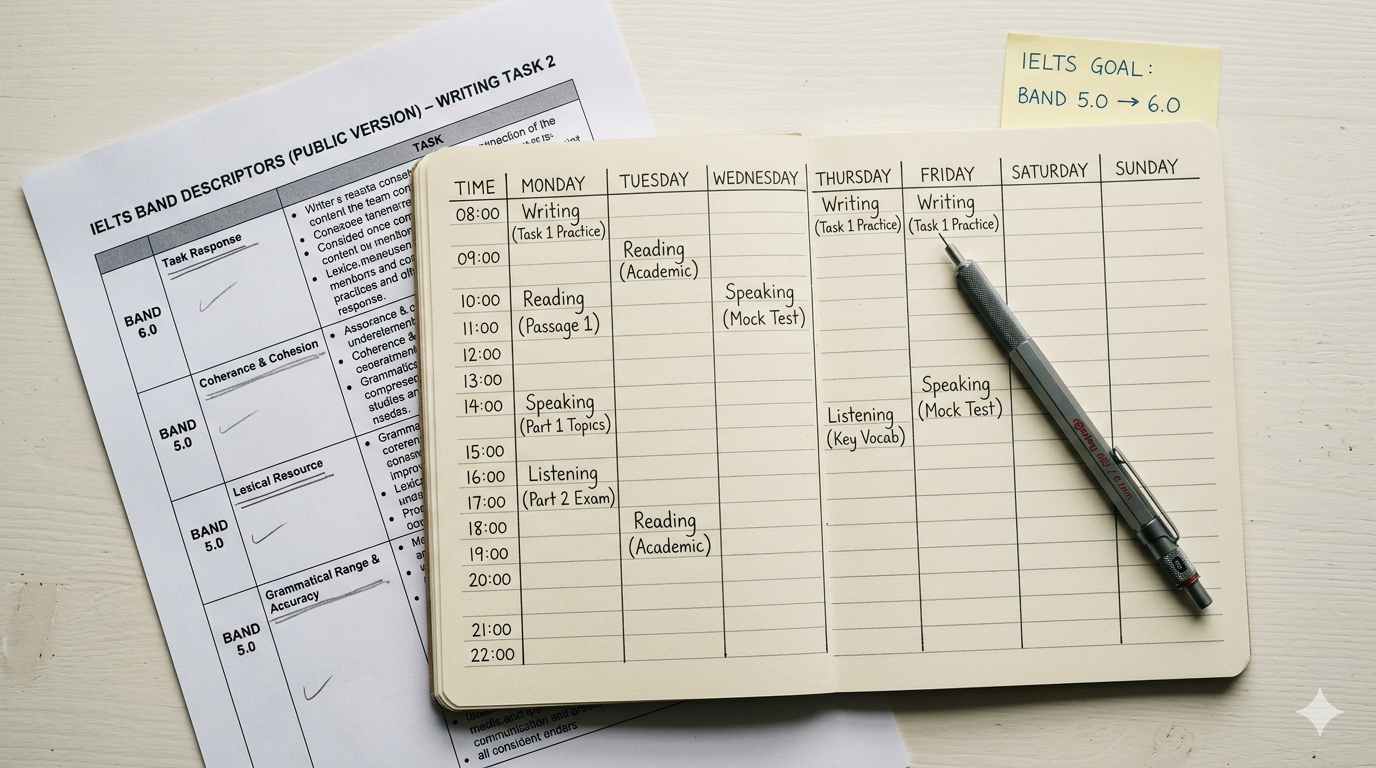
IELTS band 6.5 in short
IELTS has no official description for 6.5. It sits between band 6, a "competent user", and band 7, a "good user", and it is the top of the CEFR B2 range. To get 6.5, you need about 26 correct answers out of 40 in Listening, about 27 in Academic Reading (about 32 in General Training Reading), and Writing and Speaking where some of the marking criteria already reach band 7.
- Overall 6.5 needs your four skill scores to add up to 25 or more. An average of 6.25 rounds up to 6.5.
- 6.5 is a common minimum for postgraduate study, so many learners need it for a master's degree.
- From 6.0, the gap is usually precision, not knowledge: a clear position, ideas that are fully developed and fewer small errors.
How many correct answers do you need for band 6.5?
Listening and Reading each have 40 questions. Your number of correct answers is converted to a band score. Writing and Speaking are marked against four criteria each, so they have no correct answers.
Approximate. IELTS publishes average marks of 23 and 30 for Listening and Academic Reading bands 6 and 7, and 30 and 35 for General Training Reading. Exact numbers change a little between test versions. CEFR levels are a rough comparison.
Add up your four scores: how far are you from 6.5?
Your overall band is the average of your four skills, rounded to the nearest half band. For 6.5, your four scores need to add up to 25 or more. A total of 24.5 gives an average of 6.125, which rounds down to 6.0. A half band in any skill adds the same amount to your total, so the easiest half band is usually in your lowest skill.
- Example: Listening 6.5, Reading 6.5, Writing 5.5 and Speaking 6.0 add up to 24.5, which is overall 6.0. Raise Writing to 6.0 and the total is 25, which is overall 6.5.
- Many courses that ask for 6.5 also ask for at least 6.0 in each skill, so a Writing score of 5.5 can stop you even with 6.5 overall.
Key insight
Add up your four scores now and find your total in the table below. For every band, see IELTS band scores explained.
How far is your total from 6.5?
Add your four skill scores together, find your total, and see what the gap means in practice.
- Overall band
- 5.5
- Points to 6.5
- 2.5 to 4.0
- What that could look like
- Progress in more than one skill, not just one
- Overall band
- 6.0
- Points to 6.5
- 2.0
- What that could look like
- Half a band in all four skills, or a full band in two
- Overall band
- 6.0
- Points to 6.5
- 1.5
- What that could look like
- Half a band in three skills
- Overall band
- 6.0
- Points to 6.5
- 1.0
- What that could look like
- Half a band in two skills, or a full band in one
- Overall band
- 6.0
- Points to 6.5
- 0.5
- What that could look like
- Half a band in just one skill
- Overall band
- 6.5
- Points to 6.5
- 0
- What that could look like
- You already have 6.5. Check each skill meets your course minimum.
The overall band is the average of the four skills. An average ending in .25 rounds up to the next half band, and .75 rounds up to the next whole band. Totals go up in steps of 0.5 because each skill is scored in half bands.
See how long band 6.5 will take you
Enter your scores, exam date and study time to see the band you could reach by your exam and what to study each day. About 1 minute, no sign up needed.
How long does it take to go from 6.0 to 6.5?
Half a band is a realistic goal for many learners over about three months. In one IELTS research study, learners who prepared for 12 weeks gained about 0.3 of a band overall on average, and about 60% gained half a band or more. Your own timeline depends on your total, which skills are lowest and how much time you have.
- Total of 24 or 24.5: you are one or two half bands away. A few focused weeks on your lowest skill can be enough.
- Total of 23 or 23.5: plan for around three months of regular practice in more than one skill.
- From 5.5, 6.5 is a full band. Of 67 learners on ClayLingua at 5.0 or 5.5, 31% set 6.5 as their target, so this is a common plan, but it usually takes longer than three months.
Note
Research gives averages, not promises. At this level, the mistakes that remain are smaller and harder to notice in your own work, so feedback on your Writing and Speaking becomes more important.
What 6.5 actually means: some criteria at 7
Writing and Speaking are each marked on four criteria. A Writing or Speaking score of 6.5 usually means some of your criteria are already at band 7 while others are still at 6. So the fastest way to 6.5 is to find the criteria still at 6 and lift those, not to improve everything at once.
- Writing criteria: Task Response (Task Achievement in Task 1), Coherence and Cohesion, Lexical Resource, and Grammatical Range and Accuracy. Task 2 counts for more than Task 1.
- Speaking criteria: Fluency and Coherence, Lexical Resource, Grammatical Range and Accuracy, and Pronunciation.
- At band 7, Writing needs a clear position, main ideas that are extended and supported, some less common vocabulary used accurately, and frequent sentences with no errors.
- At band 7, Speaking needs long answers without noticeable effort, some less common and idiomatic words, and frequent sentences with no errors.
Key insight
Ask a teacher to mark one essay by each criterion, not just with one overall band. A 6 in Task Response and a 7 in vocabulary needs a very different plan from the opposite.
Which skills to focus on first
In IELTS's results for Thai Academic test takers (2024 to 2025), the average was 6.54 in Reading, 6.24 in Listening, 5.95 in Speaking and 5.81 in Writing. So many Thai learners already have Reading near 6.5 and need Writing and Speaking to catch up.
- Writing: the lowest average for Thai test takers, and the skill that improved most in a 12 week IELTS study. Usually the best return on your time at this level.
- Speaking: also below 6 on average, and the slowest skill to improve. Start daily practice early.
- Reading and Listening: if yours are already 6.5 or 7, keep them there with one timed section a week each. If one of them is your lowest skill, it may be your quickest half band, because it counts exactly the same as a half band in Writing.
Key insight
Averages describe all Thai test takers, not you. Start with your own lowest skill, and check whether your course sets a minimum for each skill.
What to study for each skill
From 6.0 to 6.5, most of the gain comes from precision. Here is what to work on in each skill.
- 1Writing
Develop every idea fully
At band 6, some main ideas are not fully developed, or stay too general. At band 7, each main idea is extended and supported. For every body paragraph, use a simple chain: one clear main idea, an explanation of why it is true, a specific example, and a sentence that links back to the question. Write your position in the introduction and keep it the same until the conclusion.
GoalOne timed Task 2 essay per week. After writing, underline the main idea of each paragraph and check it has an explanation and a specific example. Get at least one essay a month marked by criterion.
- 2Speaking
Longer answers in Part 3
Part 3 is where band 7 answers stand out. The examiner asks abstract questions about society, and a short opinion is not enough. Give your answer, a reason, an example or a comparison, and then consider another view. Phrases such as 'it depends on', 'on the other hand' and 'that said' help you extend your answer naturally.
GoalAnswer three Part 3 questions out loud every day and record them. Each answer should last at least 45 seconds, with a reason, an example and one contrast. The speaking drills give you new prompts.
- 3Reading
Accuracy on the hardest question types
At 6.5 you need about 27 correct answers in Academic Reading, so you can only miss about 13. Many learners at this level lose most of their marks on True, False, Not Given and on matching headings. For True, False, Not Given, decide whether the passage says the same thing, the opposite, or nothing at all, and never use your own knowledge.
GoalOne timed Reading section per week. Keep a list of every wrong answer by question type, and practise your weakest type, for example with the True, False, Not Given drill.
- 4Listening
Parts 3 and 4
Most learners at 6.0 already do well in Parts 1 and 2. The extra marks for 6.5 come from Parts 3 and 4, where speakers discuss, disagree and change their minds. Listen for words that signal a correction, such as 'actually' or 'in fact', because the first answer you hear is not always the final one.
GoalOne timed Listening section per week, for example from a ClayLingua mock test. Review every wrong answer with the transcript.
Band comparison
Band 6 and band 7 Writing: the same paragraph
Task 2 question: 'In many countries, people are working longer hours. What are the causes of this, and what effects does it have on individuals and society?'
There are several reasons why people work longer hours nowadays. Firstly, the cost of living is increasing, so people need more money to pay for housing and food. Secondly, many companies want their employees to work more because of competition. As a result, people have less time for their family and their health becomes worse.
- ✗Relevant ideas, but each one is stated rather than explained. Why does competition lead to longer hours?
- ✗No specific example to support the ideas.
- ✗Accurate but mechanical linking ('Firstly', 'Secondly', 'As a result') that lists ideas instead of connecting them.
One major cause is the rising cost of living, particularly housing in large cities. In Bangkok, for example, many young workers do overtime or take a second job simply to cover their rent, which leaves little time for anything else. Competition between companies adds to the pressure, since firms that operate around the clock often expect staff to be available outside normal office hours. Over time, this erodes both family life and personal health.
- ✓Each cause is explained: the paragraph shows why it leads to longer hours.
- ✓A specific example ('In Bangkok, for example...') supports the main idea.
- ✓Less common vocabulary used accurately ('around the clock', 'adds to the pressure', 'erodes'), and linking that follows the ideas.
Band comparison
Band 6 and band 7 Speaking: the same question
Part 3 question: 'Why do you think some people prefer to live in big cities?' Both answers are written out from speech. Pronunciation is also marked, but it cannot be shown in text.
I think because big cities have more opportunities. For example, in Bangkok there are many companies, so it is easier to find a good job with a high salary. Also there are many things to do, like shopping malls and restaurants. But it is very crowded and the traffic is terrible, so some people don't like it.
- ✗A clear answer with a reason and an example.
- ✗Mostly accurate, but the vocabulary is common ('many things to do', 'very crowded') and the linking is simple ('Also', 'But', 'so').
- ✗The answer moves to the opposite view at the end without connecting it to the question.
Mainly for career reasons, I'd say. Most of the well paid jobs in Thailand are concentrated in Bangkok, so if you want to work in finance or tech, you more or less have to be there. Beyond work, cities offer a kind of anonymity that some people really value. Nobody knows your business, which can feel quite freeing if you grew up in a small community. That said, I think the appeal fades for a lot of people once they start a family.
- ✓Less common and idiomatic language used naturally ('concentrated in', 'more or less', 'anonymity', 'the appeal fades').
- ✓Each idea is developed, including a second, less obvious reason.
- ✓'That said' brings in another view and links it back to the question.
Mistakes that keep Thai learners at 6.0
At band 6, your mistakes rarely stop the examiner understanding you. What keeps the score at 6 is usually a pattern of small problems that make your English less precise. These four are common for Thai learners at this level.
- General statements instead of developed ideas. 'Technology is very important in our life' tells the examiner nothing new. Band 7 needs the reason and a specific example.
- Memorised phrases. 'Every coin has two sides' and similar phrases are easy for examiners to recognise. Memorised language is not credited as evidence of your real vocabulary.
- Articles and plurals. At band 6 they no longer confuse the meaning, but they appear often enough to keep Grammatical Range and Accuracy at 6.
- Short Part 3 answers. Many learners answer abstract questions in one or two sentences. At band 7, the examiner expects you to explain and extend your view.
Key insight
Pick one of these patterns and check your last three essays or recordings for it. Fixing one pattern that appears ten times is worth more than learning ten new words.
This Task 2 body paragraph would score around band 6. Rewrite it to reach band 7: remove the memorised phrase, explain the main idea, and add a specific example.
"Question: Some people think children should start learning a foreign language at primary school. Others think it is better to start at secondary school. Discuss both views and give your opinion."
"Every coin has two sides. Some people think children should learn a foreign language at primary school because it is good for them. Young children can learn languages easily. For example, many children in my country learn English when they are young. Therefore, starting early is better."
A 12 week plan to go from 6.0 to 6.5
This plan assumes you are at 6.0 and Writing or Speaking is your lowest skill. If your lowest skill is Reading or Listening, swap the weekly focus.
- 1Weeks 1 and 2
Find which criteria are still at 6
Take a full timed IELTS mock test to confirm your score in each skill. Then get one Task 2 essay and one Speaking recording assessed criterion by criterion, by a teacher if possible. Write down the two criteria that are furthest from 7.
GoalBy the end of week 2: you know your four skill scores, your total, and the two criteria to work on.
- 2Weeks 3 to 6
Fix development and precision
Write one Task 2 essay a week using the chain of main idea, explanation, example and link. Start a collocation notebook: every time you look up a word, write down two words that often go with it. Answer three Part 3 questions out loud every day. For daily vocabulary, the IELTS vocabulary guide explains a method that works.
GoalBy the end of week 6: every body paragraph you write has a specific example, and your Part 3 answers last at least 45 seconds.
- 3Weeks 7 to 10
Timed practice with feedback
Add one timed Reading and one timed Listening section each week, and review every wrong answer by question type. Get at least two essays marked by criterion in this phase. Our list of free IELTS resources for Thai students includes free places to get feedback.
GoalBy the end of week 10: the criteria you wrote down in week 2 have moved, and you know which question types still cost you marks.
- 4Weeks 11 and 12
Switch to exam conditions
Take full mock tests under real exam conditions and review them in detail. Do not start new topics now. Use these weeks to make your timing and technique automatic.
GoalBy exam day: your mock test scores add up to 25 or more.
Create your free personalised band 6.5 study plan
See the band you could reach by your exam, which skills to focus on first, and what to study each day.
About 1 minute · No sign up needed.
Step 1 of 6
What band do you need?
Your overall IELTS target.
Mistakes that stop students reaching 6.5
These four habits are the most common reasons a 6.5 plan does not work.
- 1Mistake 1
Practising more instead of practising differently
At 6.0, doing more of the same practice often keeps the same score. Ten essays with the same weaknesses are ten band 6 essays. Without feedback on which criteria are below 7, extra practice repeats the problem.
GoalChoose one criterion to work on for each essay and check it before you finish. Get feedback by criterion at least once a month.
- 2Mistake 2
Using memorised templates
Templates help at band 5 because they give structure. At 6.5 they hold you back: the same opening and linking phrases in every essay, whatever the question. Examiners are trained to notice memorised language, and it does not show your real range.
GoalWrite your introduction from the question each time. Keep a structure, but use your own words.
- 3Mistake 3
Ignoring the minimum for each skill
Many courses that ask for 6.5 overall also ask for 6.0 in every skill. Learners sometimes reach 6.5 with 5.5 in Writing and still cannot use the result.
GoalCheck your course requirements now, and make sure your plan lifts any skill below the minimum.
- 4Mistake 4
Booking the test before your practice scores are there
Many learners book a date first and hope their score will follow. If your timed practice scores do not add up to 25 yet, another attempt often gives a similar result.
GoalBook when two full mock tests in a row add up to 25 or more, or plan more weeks before your date.
Which plan gives this student the best chance of reaching 6.5?
Student profile
- Listening 6.5 · Reading 6.5 · Writing 5.5 · Speaking 6.0 (total 24.5, overall 6.0)
- Goal: 6.5 overall with no skill below 6.0, for a master's degree
- Study time: 1 hour per day for 10 weeks
Is IELTS 6.5 good?
Yes. IELTS 6.5 is above the 6.2 average for Thai Academic test takers in 2024 to 2025, and it is the top of the CEFR B2 range. IELTS describes band 6 as an effective command of English despite some inaccuracies, and band 7 as an operational command with only occasional inaccuracies. At 6.5 you are between the two.
- 6.5 is a common minimum for postgraduate courses in the UK and Australia, often with no skill below 6.0. Always check your exact course page.
- Some competitive courses, and many courses in subjects such as medicine and law, ask for 7.0 or higher.
- If you need 7.0, read how to get IELTS band 7. If you are below 6.0 now, start with how to get IELTS band 6.
Is IELTS 6.5 hard?
From 6.0, 6.5 is half a band, and many learners reach it in about three months of focused practice. From 5.5, it is a full band, which usually means progress in at least two skills and takes longer. What makes 6.5 hard is that the gap is in quality, not knowledge: you already know the grammar and the question types, and now each idea has to be developed and each sentence more accurate.
IELTS 6.5: frequently asked questions
Is IELTS 6.5 hard?
From 6.0 it is half a band, and many learners reach it in about three months of focused practice. From 5.5 it is a full band and usually takes longer. The hard part is quality: developed ideas, precise vocabulary and fewer small errors.
How many correct answers do I need for IELTS 6.5?
About 26 to 29 out of 40 in Listening, 27 to 29 in Academic Reading, and 32 to 33 in General Training Reading. The exact conversion can vary slightly between tests.
What CEFR level is IELTS 6.5?
IELTS 6.5 is the top of the CEFR B2 range. IELTS 7.0 is the start of C1.
What scores do I need in each skill to get IELTS 6.5?
Your four scores need to add up to 25 or more, because the average is rounded to the nearest half band. For example, 7.0, 6.5, 6.0 and 5.5 add up to 25 and give 6.5 overall. Many courses also ask for at least 6.0 in each skill, so check yours.
How long does it take to go from IELTS 6.0 to 6.5?
Around three months of regular practice is a realistic plan for many learners. In one IELTS study, learners gained about 0.3 of a band on average over 12 weeks. A free IELTS study plan shows your own timeline.
Is IELTS 6.5 enough for a master's degree?
For many master's programmes in the UK and Australia, yes, often with at least 6.0 in each skill. Competitive programmes may ask for 7.0. Always check the exact entry requirements for your course.
What is the difference between IELTS 6.0 and 6.5?
At 6.5, some of your Writing and Speaking criteria are already at band 7, for example a clear position developed through the whole essay, or longer Speaking answers with less common vocabulary. At 6.0, most of them are still at 6.
Find out how long band 6.5 will take you
See the band you could reach and exactly what to study each day.
Sources
- IELTS: Understanding your score. Band descriptions, average marks for each band and the rounding rule
- IELTS: Test statistics 2024 to 2025. Average scores by nationality, including Thai Academic test takers
- Kang et al. (2021), IELTS Research Report: learner background, linguistic progression and score gain. Score gains over 12 weeks of preparation (52 learners in Korea)
- IELTS Writing band descriptors. What examiners look for at band 6 and band 7
- IELTS Speaking band descriptors. What examiners look for at band 6 and band 7
- IELTS guide for teachers. CEFR and IELTS comparison